On April 26, 2025, a concert celebrating the life, artistry, and fellowship of Martin Lodge was held. The concert was organised by Martin’s friends and colleagues. The new album, Aeon is a loving tribute from some of Martin’s closest colleagues: John Psathas, Michael Williams, Gillian Whitehead, Kenneth Young, Eve de Castro-Robinson and of course myself.
The music on this album is performed by Jade String Quartet (Miranda Adams, Kathryn Taylor, Robert Ashworth, James Yoo), Jonathan Jung (piano), Ashley Brown (cello), Tessa Brinckman (flute), and Lara Hall (violin).
You can buy and/or listen to the entire album here:
https://rattle.co.nz/catalogue/releases/aeon
Among his peers, Martin is regarded as one of the most important figures in New Zealand contemporary music of the last 70 years. His eclectic musical style blended Western classical traditions, Māori musical elements, and natural soundscapes. He was especially interested in the potential of music to acutely reflect the interior landscapes of many people.
About The Rest Is Silence
Martin and I began composing together on the 5th of August of 2024, five months before he passed away. By this time, his health was in decline.
I had made my way to see him around 11am, essentially an early lunch break. At this point, he was struggling to write, move, and speak. Sitting at home in his Newstead music room, it was clear that Martin had strong ideas for what he knew would be his final composition. While I sat at the harpsichord, Martin hummed what would be our pitch set for The Rest is Silence.
Martin and I talked about the structure and shape of the piece, what it might convey and how it would sit among the other pieces in the Aeon project.
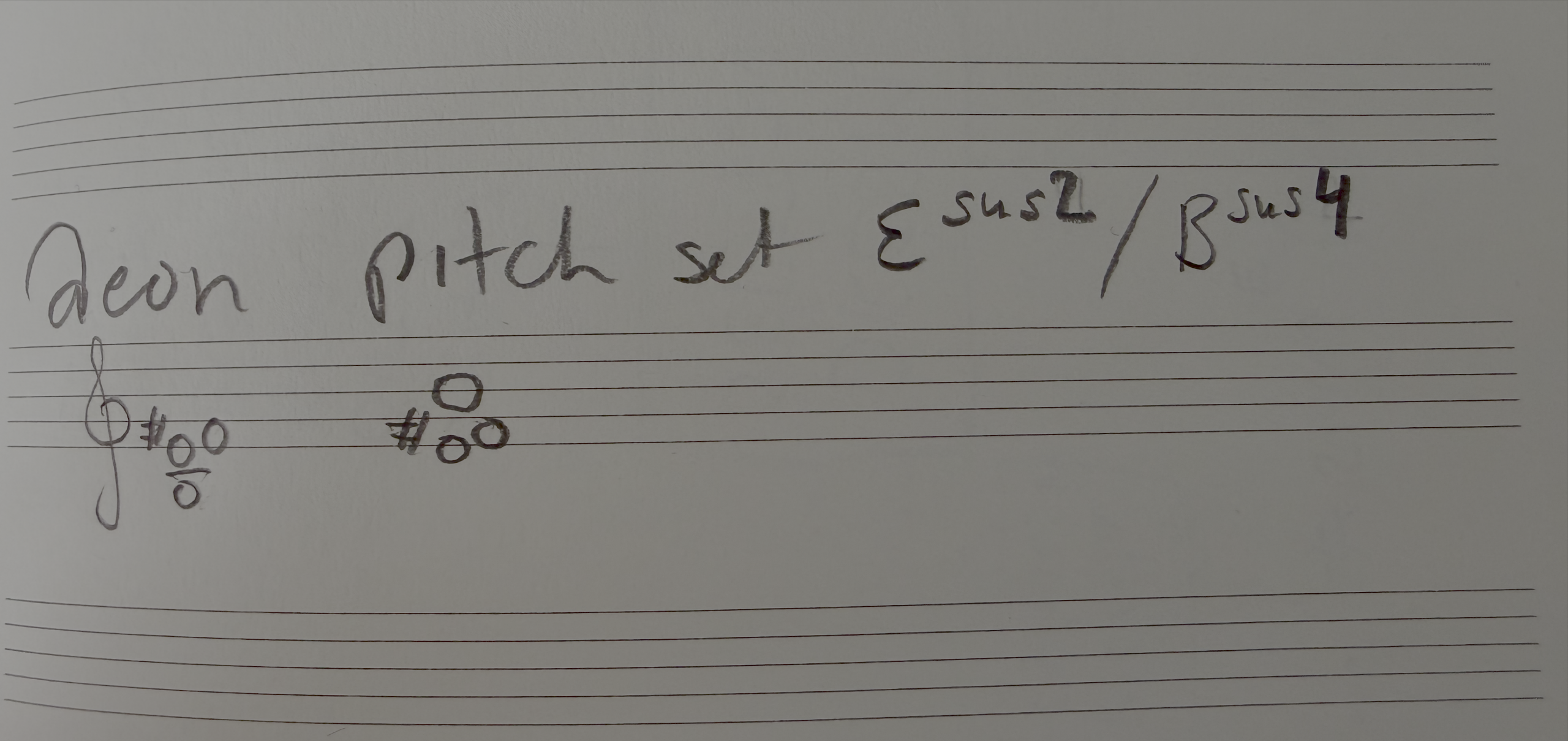
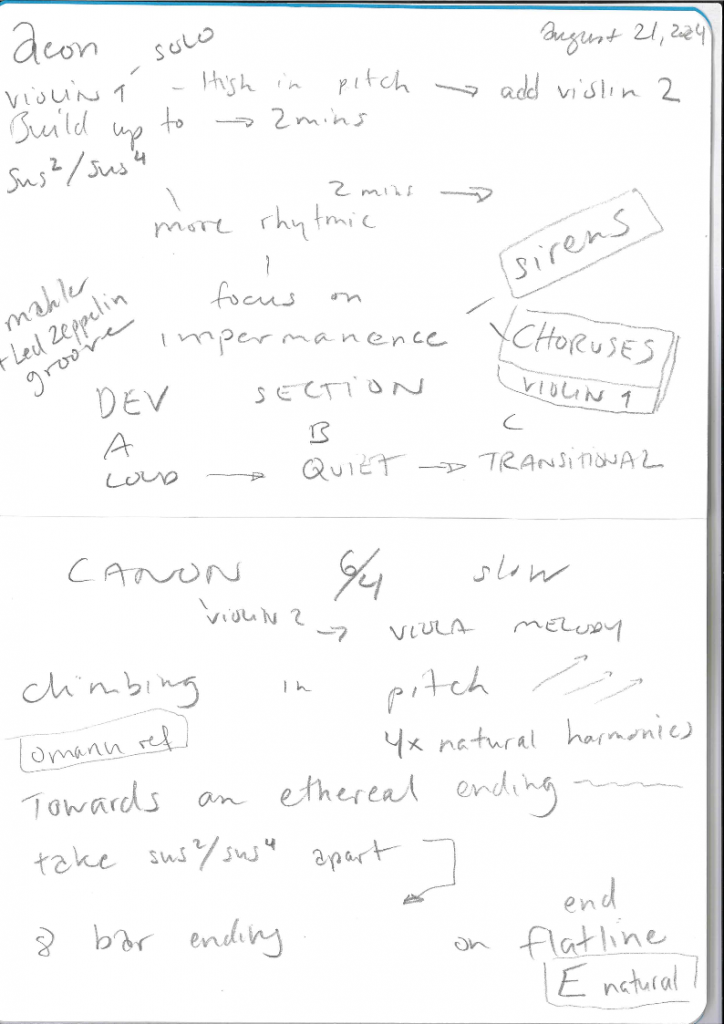
As per Martin’s instruction, the piece begins with the first violin playing the five notes in the set, one by one, slowly and delicately, like the soul of a person floating around a room.
The pitches then take flight, first with deliberation, then in new and jagged shapes, bouncing with alacrity before finally settling into a canon. The piece finds its final resting place with all four players joined on a high E natural. As I tend to work out a piece beforehand architecturally, we sketched out this plan:
Martin loved musical-cryptograms, and in this piece, you may discover not only Martin’s own name in musical notation, but also those of his family, friends and collaborators.
Unfortunately, shortly after we began The Rest Is Silence, Martin had a bad fall and had to be taken to hospital, where his health further declined. He eventually was able to return home, but was bedridden and no longer responsive. I visited once a week and was able to sit with him as he slept. I would hum a few bars from our piece, a small fragment from the canon in the latter part, hoping he’d might enjoy it as a kind of lullaby.
Finishing the piece on my own, I wanted to incorporate as much of Martin’s musical interests as well, so you may find a nod to Mahler and Led Zeppelin.
Although, I had to complete this work on my own, I always felt Martin’s presence as I worked out the jagged rhythms, the leaps and bounds, the joy and the silence.
Score is published by SOUNZ.
Dr. Gail Pittaway (Martin’s wife) gave an interview on RNZ Concert talking about this project: https://www.rnz.co.nz/concert/programmes/three-to-seven/audio/2019036231/aeon-commemorating-martin-lodge